
Race craft · The difficulty ranking
The 8 HYROX Stations Ranked by Difficulty
Ask ten athletes for the hardest HYROX station and you get ten stories about the day they blew up. This ranking uses something better: how much of your finish time each station actually takes, from the split model behind our race time calculator, weighted by how strictly each station is judged and where it lands in the race. Counted down from easiest to hardest — with the one cue that matters at each.
The ranking at a glance
| Rank | Station | Share of finish | Cost at 1:30 |
|---|---|---|---|
| 1 | Wall Balls | 8.5% | 7:39 |
| 2 | Burpee Broad Jumps | 6.5% | 5:51 |
| 3 | Sled Pull | 6% | 5:24 |
| 4 | Sled Push | 5.5% | 4:57 |
| 5 | Sandbag Lunges | 5.5% | 4:57 |
| 6 | SkiErg | 5% | 4:30 |
| 7 | Rowing | 5% | 4:30 |
| 8 | Farmers Carry | 3% | 2:42 |
Time shares from typical solo split distributions — the same model as the calculator
How to read it: about 48% of a typical race is running and 7% is Roxzone, so the stations split the remaining ~45% between them — and they do not split it evenly. Wall balls cost nearly three times what the farmers carry does. Difficulty here is that time share, adjusted for two things the clock alone can't see: how strictly a station is judged, and how wrecked you are when you meet it. Loads below are Open division; every division's numbers live in the weights & standards reference, and standards come from public 2025/26 season rules — verify with the official rulebook.
#8. Farmers Carry — 3% of your race
The smallest time bill on the course: roughly 2:42 of a 1:30 race. 200m with 2×24kg / 2×16kg in Open (2×32kg / 2×24kg Pro), no rep standard, no judge to please. It breaks exactly one kind of athlete: the one whose grip gives out. Every drop costs the stop, the shake-out, the pick-up, and the re-acceleration — 5–10 seconds each, on the cheapest station of the day.
Who suffers most: athletes who never train loaded carries. Grip endurance is stubbornly specific — a big deadlift does not buy you an unbroken 200m.
Coach's cue · Farmers carry
Grip tight, shoulders packed, quick feet — fast walk, no stopping.
Full loads and faults on the farmers carry station page.
#7. Rowing — 5% of your race
1000m at station 5 — about 4:30 at 1:30 pace, and the only seated moment in the entire event. The machine counts the metres, so there is nothing to no-rep; ridden with long, patient strokes it actually gives something back, which is why it ranks low. It breaks people one way: rowing it like a 500m test and standing up dizzier than you sat down.
Who suffers most: athletes with no stroke sequencing — arms-first pullers turn the one recovery station into another arm-burner, and pay for it on the farmers carry two stations later.
Coach's cue · Rowing
Legs–back–arms. Long pull, full extension — never arms first.
Pacing the pivot station is covered in the first-race pacing guide; standards on the rowing station page.
#6. SkiErg — 5% of your race
Same distance, same share of the race (1000m, ~4:30 at 1:30) — but the SkiErg ranks above the row for one reason: position. It is station 1, your adrenaline is peaking, everyone around you is sprinting the fan, and the bill for joining them arrives 500m later at the sled push. No judged standard, no drama — just the two easiest minutes on the course to overspend invisibly.
Who suffers most: athletes who pull with their arms instead of hinging from the hips and lats — and anyone who races the lane next to them instead of their own plan.
Coach's cue · SkiErg
Hinge and rip down with the lats. Long strokes — don't sprint the fan.
Distance and technique on the SkiErg station page.
#5. Sandbag Lunges — 5.5% of your race
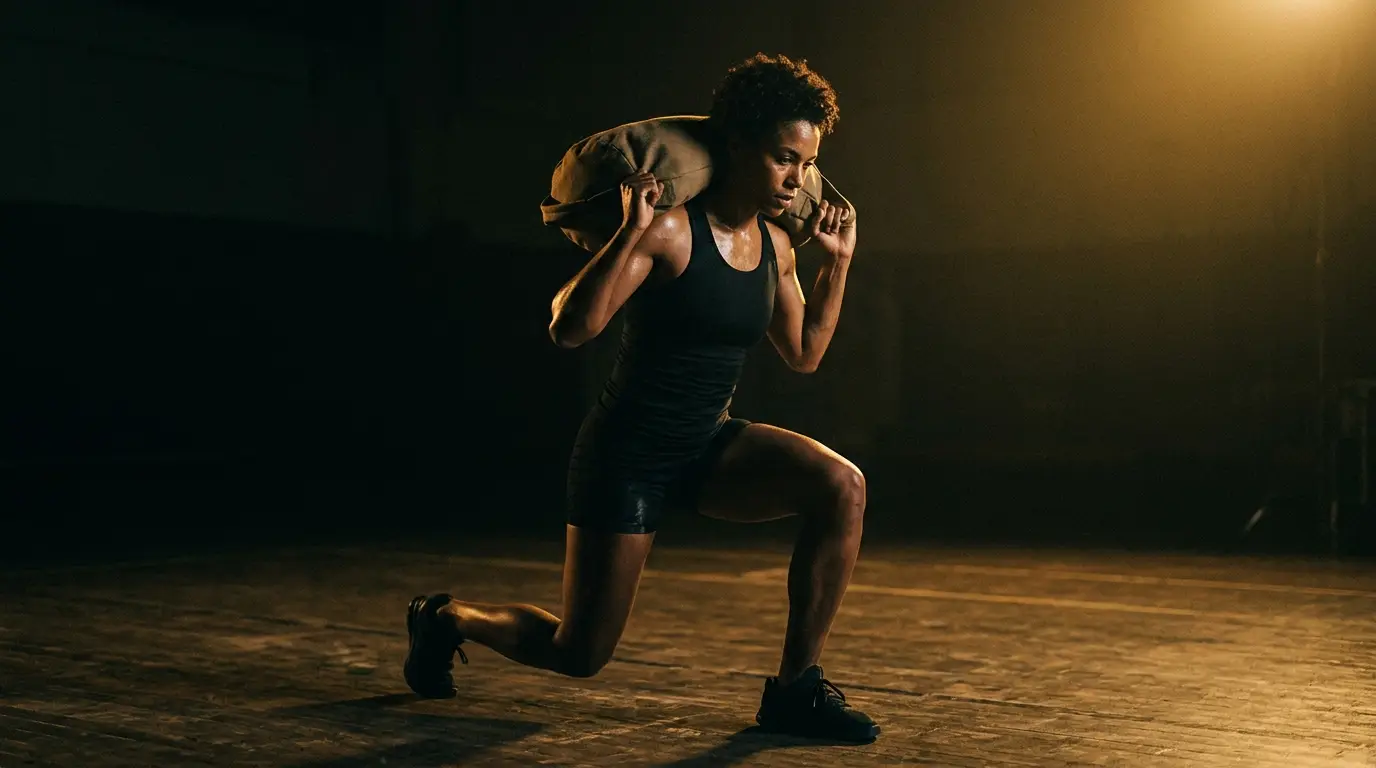
100m at 20kg / 10kg Open (30kg / 20kg Pro), about 4:57 of a 1:30 race. The judged standard is single and brutal: the rear knee touches the floor on every rep — and a knee hovering 2cm up feels identical to one that touches when your quads are gone. It is the second most no-repped station on the course, and it sits at station 7, quietly deciding what you have left for wall balls.
Who suffers most: athletes who arrive with quads already cooked — usually the ones who muscled both sleds instead of pacing them. Weak single-leg strength turns 100m into a very long address.
Coach's cue · Sandbag lunges
Knee kisses the floor, step through, hips tall. Short steady steps.
The knee-touch call and its cost are in the no-reps & penalties guide; loads on the sandbag lunges station page.
#4. Sled Push — 5.5% of your race
The most feared station is only fourth. 50m (4×12.5m) at 152kg / 102kg in Open (202kg / 152kg Pro) takes about 4:57 of a 1:30 race — but its real signature is the biggest heart-rate spike on the course, and the famously ugly kilometre that follows it. It breaks people through physics: a moving sled asks for sliding friction, a stopped sled demands a static-friction restart that costs several seconds of maximal grind. Every unplanned mid-lane stall converts the cheap problem into the expensive one.
Who suffers most: lighter athletes — body mass is leverage here, and a 102kg sled asks a 60kg athlete a much harder question than it asks an 85kg one. Slow venue carpet compounds it.
Coach's cue · Sled push
Low hips, arms locked, short choppy steps.
The full stall-proofing mechanics are in the sled push technique deep dive; loads on the sled push station page.
#3. Sled Pull — 6% of your race
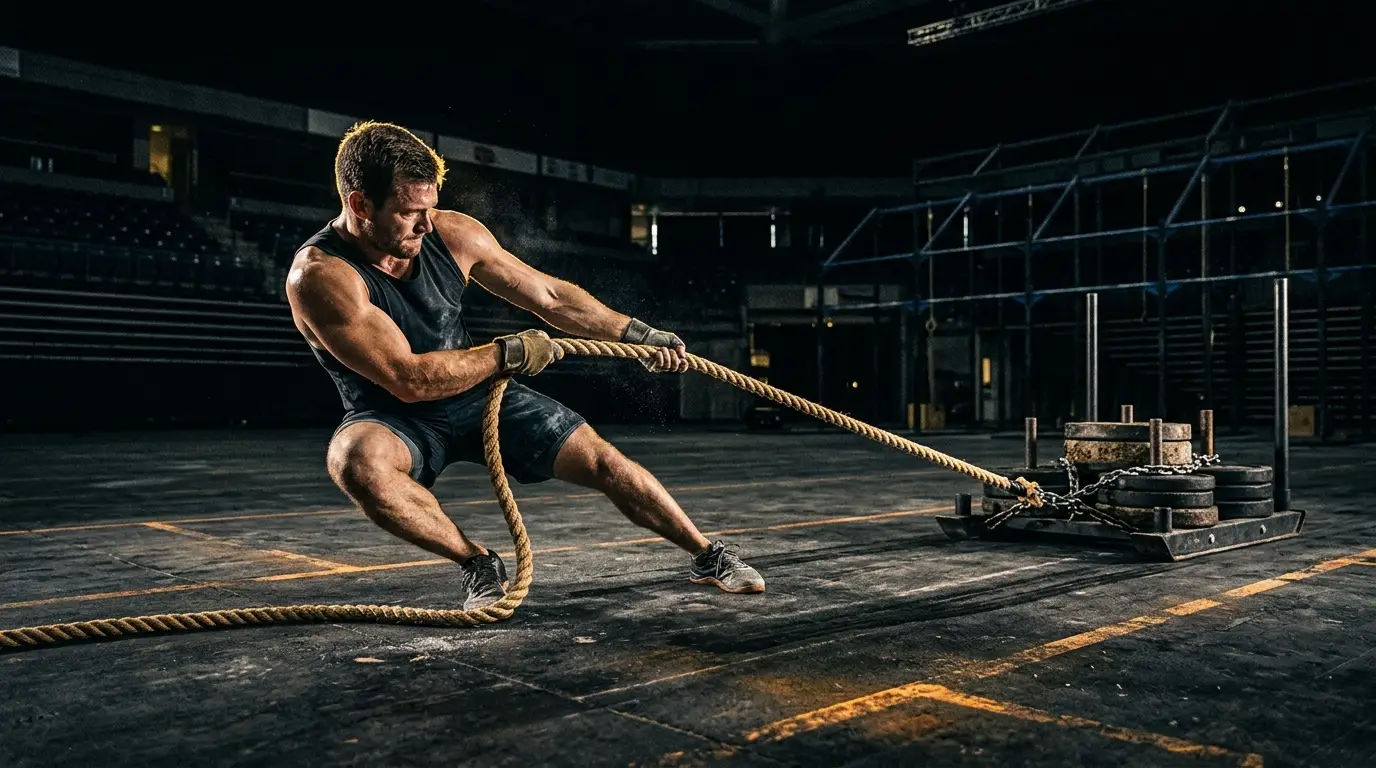
Here is the ranking's first upset: the pull takes more of your race than the push — 6% versus 5.5%, roughly 5:24 at 1:30. Same 50m (4×12.5m) format, lighter sled (103kg / 78kg Open, 153kg / 103kg Pro), yet most athletes are slower on it, because the effort keeps getting interrupted: hand-over-hand grip fatigue, slack rope piling under your feet, and the most positional rule on the course — work from inside the marked zone or the judge sends you back.
Who suffers most: lighter athletes again, and anyone with an untrained posterior chain — without body weight to anchor against, the sled wins the tug-of-war. Sloppy rope management makes it worse at any size.
Coach's cue · Sled pull
Sit low, anchor the feet — rip with hips and lats, walk the rope in.
Zone rules and warnings are in the no-reps guide; loads on the sled pull station page.
#2. Burpee Broad Jumps — 6.5% of your race
80m, no load in any division, about 5:51 of a 1:30 race — the second-biggest station share on the course. Station 4 is the peak metabolic moment of the first half: you arrive off both sleds, and it is the only station that takes your whole body from floor to airborne on every rep. Three judged parts per rep — chest to the floor, two-footed take-off, jump from where you landed — and judges call all three constantly, because fatigue pushes athletes into every fault without them noticing. It produces more mid-race blow-ups than both sleds combined.
Who suffers most: heavier athletes, unambiguously — every rep lifts your full body weight from the floor and throws it forward. Short jumpers pay twice: 1.2m per jump means ~20 more burpees than 1.8m, over the same 80m.
Coach's cue · Burpee broad jumps
Steady rhythm, jump for distance every rep — fewer reps, same 80m.
The jump-length maths and rhythm plan are in the burpee broad jump guide; the standard on the station page.
#1. Wall Balls — 8.5% of your race
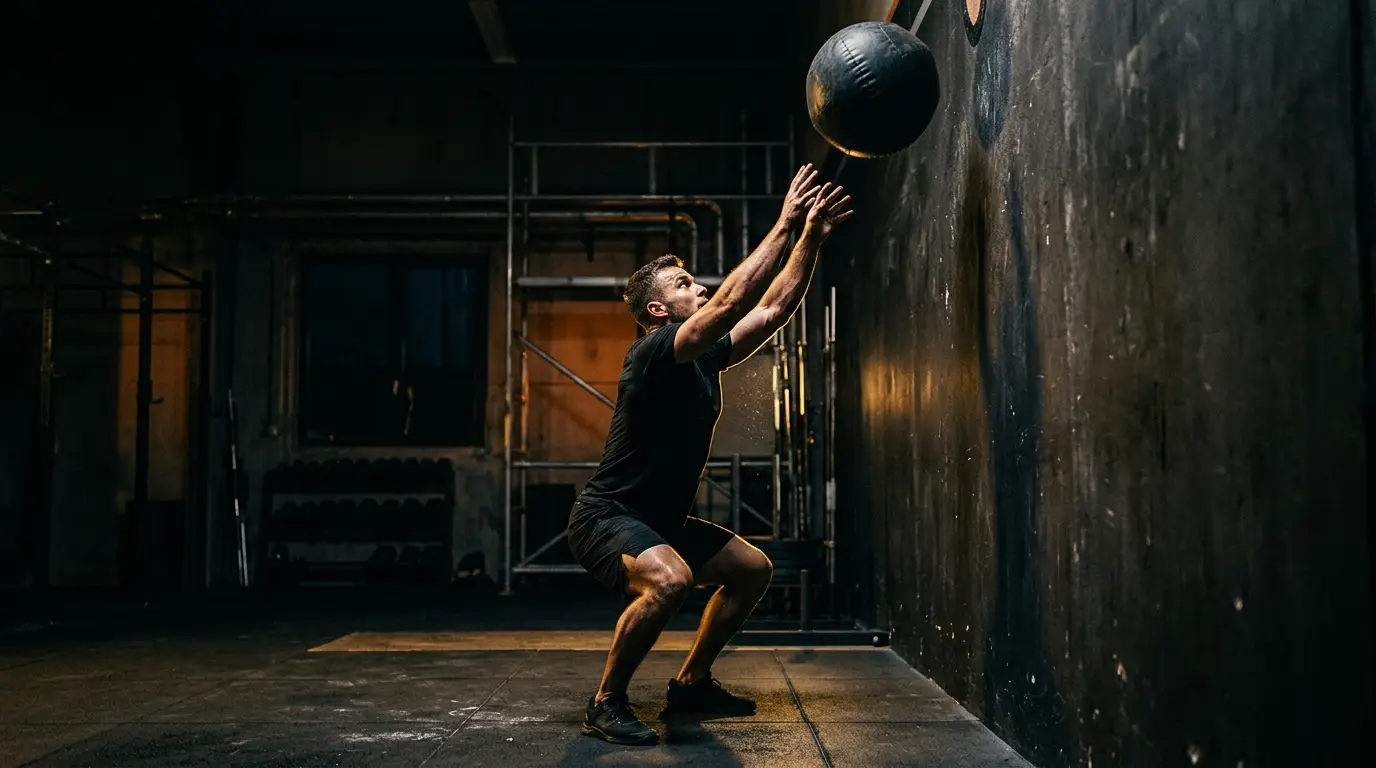
No contest, and the data agrees with the folklore: 8.5% of a typical finish — around 7:39 of a 1:30 race, the largest single station share by a distance. 100 reps (75 for women) at 6kg → 3.0m for Open men, 4kg → 2.7m for Open women (9kg → 3.0m / 6kg → 2.7m Pro). Two standards are judged on every rep — full squat depth at the bottom, ball clearly reaching the target at the top — on the final station, with the whole race already in your legs and judging at its strictest. More no-reps are called here than anywhere else on the course, and each one at rep 90 costs the failed rep, the repeat, and your rhythm.
Who suffers most: shorter athletes, who throw further to the same fixed target — and Pro men, for whom the 9kg ball turns hip drive from a technique cue into a survival requirement. But nobody escapes: this station is hard because it is last.
Coach's cue · Wall balls
Full squat, drive through the hips, eyes on the target. Big first set, then breathe.
The no-rep-proof rep and set-breaking strategy live in the wall ball technique guide; standards on the wall balls station page.
What the ranking actually tells you
Three lessons hide in the table. First, the back half owns the race: the two hardest stations (wall balls, 8.5%; burpee broad jumps, 6.5%) are exactly where pacing debt comes due — which is why the pacing doctrine protects your legs early. Second, felt difficulty and clock difficulty are different rankings: the push scares people, the pull quietly takes more of their race. Third, the judged stations cluster at the top: wall balls, burpees, and lunges are ranked where they are partly because a judge can hand your seconds back to you as no-reps. Train the standard, not near it.
Every station's full breakdown is on the stations index, more technique and strategy is on the blog, and you can turn any goal time into per-station splits with the race time calculator.
Train your rank-1 weakness first
RoxDuo's AI plans weight your training toward the stations that cost you the most — real division loads, reps under fatigue, station PBs tracked to race day. Built by Filippo Terzi, an athlete training for HYROX Rome 2026 on his own app.
Get launch accessFAQ
What is the hardest HYROX station for beginners?
Wall balls, and it is not close. Two judged standards — full squat depth and the ball clearly reaching the 3.0m/2.7m target — enforced on the final station, when a beginner's legs are at their worst. It also carries the single biggest station share of a typical finish (8.5%). The station most beginners underestimate is different: the sled push, because nothing in normal gym training prepares you for how a 152kg sled on race carpet feels at station 2.
What is the easiest HYROX station?
By the clock, the farmers carry: about 3% of a typical finish, roughly 2:42 in a 1:30 race — the smallest share of any station. There is no rep standard, just 200m at 2×24kg / 2×16kg in Open. It only becomes hard if your grip fails and the bells go down: every drop costs 5–10 seconds.
Does doubles change the station difficulty ranking?
The order mostly holds, but everything compresses. In doubles the station work is shared in any split you choose while the loads stay identical to solo, so a typical pair finishes station work far faster — but you run every kilometre together, so running becomes a bigger slice of the race. Wall balls stay hardest (100 shared reps still bites), and the sleds stay pivotal because the same 152kg Open sled must move whoever is behind it. The doubles guide covers how to split each station.
Is the sled push or the sled pull harder in HYROX?
The push feels harder — it produces the biggest heart-rate spike on the course. But the split data says the pull takes more of your race: about 6% of a typical finish versus 5.5% for the push. The pull is slower for most athletes because grip, rope management, and the marked work-zone rules keep interrupting the effort. Train both; fear the pull.
Which HYROX stations have no judged rep standard?
Three: the SkiErg and row (1000m each — the machine counts the metres) and the farmers carry (the clock, not a judge, punishes drops). Every other station has a standard a judge can no-rep — the full list is in the no-reps & penalties guide.

Launch access
Start together.
Finish together.
The AI training app for HYROX doubles. Be first when it hits the App Store — 3-day free trial at launch.