
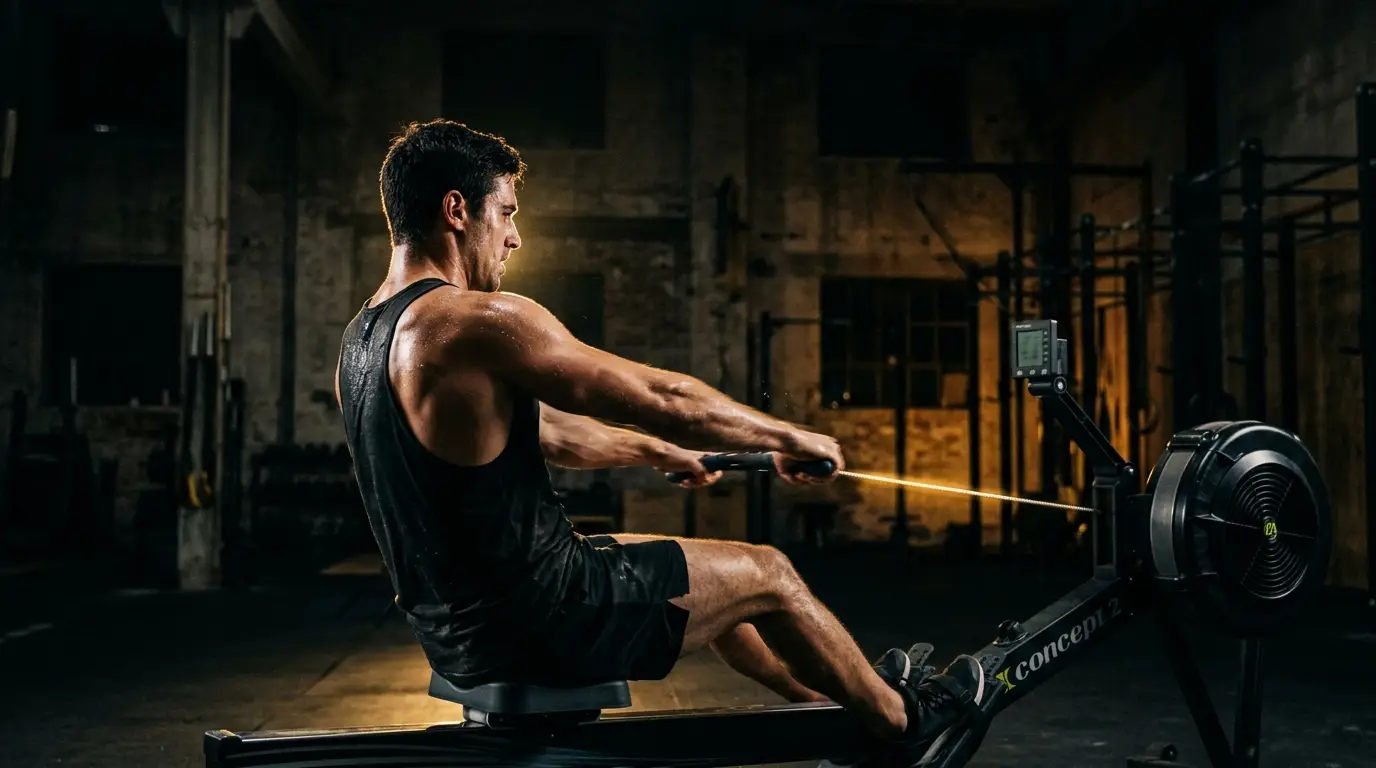
Station 5 of 8
HYROX Rowing
Station 5: 1000m on the rower, every division. On paper it mirrors the SkiErg. In race reality it is something rarer — the only seated moment in the entire event, arriving exactly when you need it.
The row is a controlled recovery that still moves the clock. Treat it as a rest and you donate 20 seconds; treat it as a time trial and you wreck the second half of your race. The skill is holding the narrow band between the two.
Official standards by division
| Division | Format |
|---|---|
| All divisions (Open, Pro, Doubles, Relay) | 1000m |
Standards from public 2025/26 season rules — verify with the official rulebook.
Coach's cue
Legs–back–arms. Long pull, full extension — never arms first.
Common faults — and what they cost
- Arms first. opening the stroke with the arms is the classic fatigue error. The sequence is legs–back–arms, every stroke — break it and your split drifts up while your effort stays the same.
- Stroke rate through the roof. short frantic strokes feel fast and go nowhere. A long pull to full extension at a lower rate produces the same split at a fraction of the heart-rate cost.
- Collapsing at the catch. slumping forward after four stations is natural and expensive — a rounded catch position robs the leg drive where most of the watts live.
- Total shutdown. rowing 15 seconds slower than your sustainable pace to "recover" rarely buys back 15 seconds of running. Recover with breathing rhythm, not with the handle.
How it fits the race
The row is station 5 of 8: Burpee Broad Jumps → Run 5 → Rowing → Run 6 → Farmers Carry. It opens the back half of the race: after the rower there are no more machines, only carries, lunges, and wall balls.
Pacing note
The row takes about 5% of a typical finish — roughly 4:30 for a 90:00 athlete. A useful rule: row noticeably slower than your fresh 1000m pace and spend the ride controlling your breathing for the farmers carry. Doubles pairs split the 1000m freely — 250m switches are standard.
Racing doubles? The split strategy for every station lives in the HYROX doubles guide, and you can see how this station affects your projected finish with the free calculator.
Train this station with a plan
RoxDuo builds the rowing into an AI plan periodised to your race date, and tracks your station PB so you can watch it drop. Built by an athlete training for HYROX Rome 2026 on his own app.
Train every station with RoxDuoPrevious station: 4. Burpee Broad Jumps · Next station: 6. Farmers Carry · All 8 stations
FAQ
How far is the row in HYROX?
1000m for every division, at station 5 of 8. Like the SkiErg, it is distance-only — no added load in any division.
How hard should I row in a HYROX race?
Comfortably below your fresh 1000m pace. The row sits mid-race after the burpee broad jumps, and its real job is stabilising your heart rate while still banking metres — most athletes race it at a firm but conversational effort, then attack the back half.
Is the HYROX row the same as the SkiErg?
Same 1000m distance, opposite movement: the SkiErg is a standing pull downward, the row a seated drive with legs first. The row is generally the easier place to control effort, which is exactly why it is positioned mid-race.

Launch access
Start together.
Finish together.
The AI training app for HYROX doubles. Be first when it hits the App Store — 3-day free trial at launch.