
Technique deep dive · Station 8
HYROX Wall Balls: The No-Rep-Proof Technique Guide
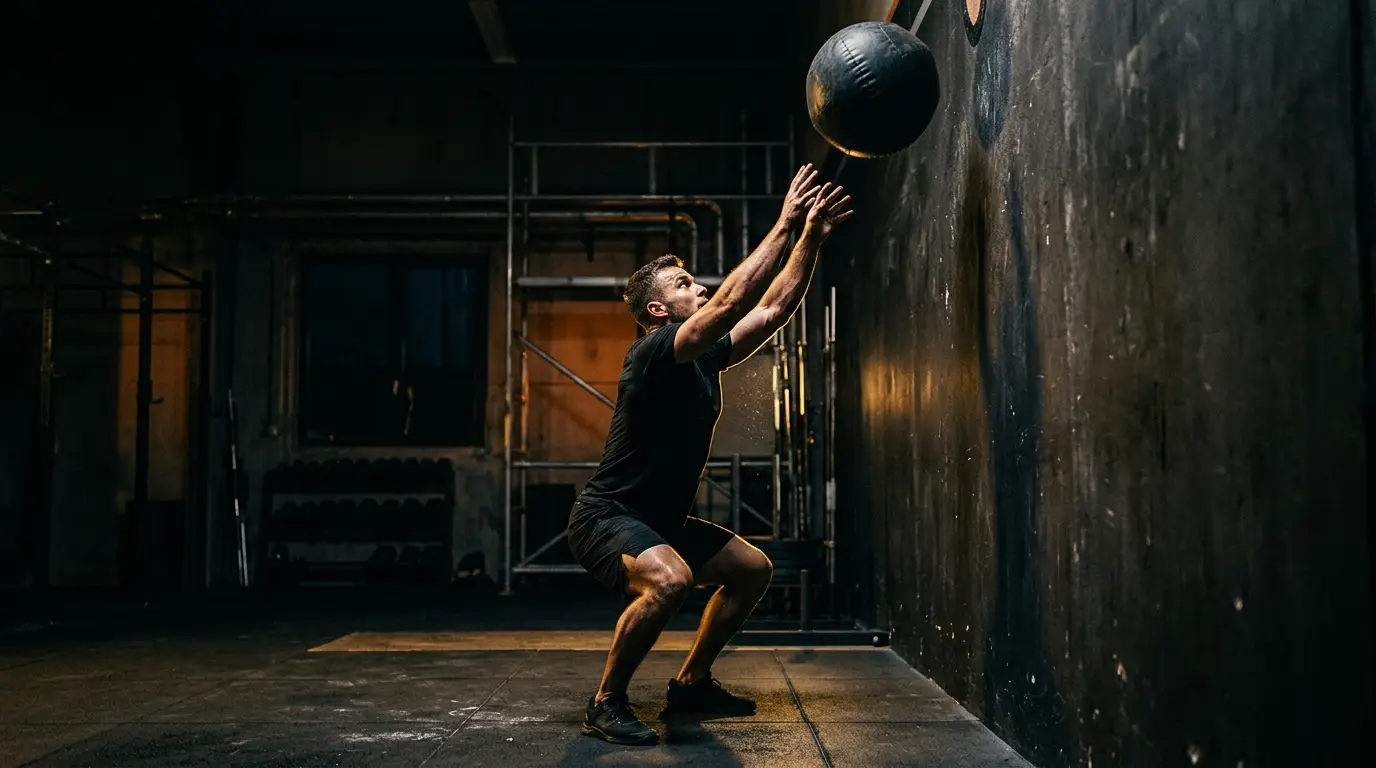
Wall balls are the last station, the largest single share of your finish time, and the place where judges call more no-reps than anywhere else on the course. Every rep has two ways to fail — depth at the bottom, target at the top — and you will be judged on both with the whole race already in your legs. Here is how to build reps that cannot be taken away.
Not sure where the danger is? Start with the stations ranked by difficulty — then pace around the top three.
The standard, exactly
| Division | Ball → target height |
|---|---|
| Open Men | 6kg → 3.0m |
| Open Women | 4kg → 2.7m |
| Pro Men | 9kg → 3.0m |
| Pro Women | 6kg → 2.7m |
Volume: 100 reps (75 for women)
Two judged checkpoints per rep: a full squat at the bottom, and the ball clearly reaching the target — 3.0m for men, 2.7m for women — at the top. A ball that grazes the line, or a squat that stops just above depth, is a no-rep: the effort is spent, the rep is repeated, and your rhythm is broken. The wider judging picture across all 8 stations is in the no-reps & penalties guide.
Standards from public 2025/26 season rules — verify with the official rulebook.
The rep that never gets called
- Squat depth with margin. Train 2–3cm below the minimum, every rep, from rep one. Depth that is exact when fresh is shallow when tired — and station 8 is the definition of tired. Give the judge nothing to think about.
- Drive with the hips, not the arms. Arm-throwing works for 10 reps and then dies; hip drive rides the ball's momentum and costs a fraction of the shoulder fatigue — which matters double for Pro men on the 9kg ball.
Coach's cue
Full squat, drive through the hips, eyes on the target. Big first set, then breathe.
- Eyes on the target the whole set. Dropping your gaze drops the ball's arc. The target height never changes; your throw should not either.
- Catch high, ride down. Catch the ball at chest height and let it push you into the next squat as one motion. Catching low or letting the ball die at your waist adds a lift to every single rep — 100 tiny lifts is a real cost.
Rhythm strategy: one breath, one rep
The athletes who look effortless on station 8 are metronomes: exhale on the throw, inhale on the ride down, one breath per rep. That rhythm caps your rep speed slightly — and that is the point. A sustainable 3-second rep cadence for 100 reps beats a 2-second cadence that collapses at rep 30 into hands-on-knees standing.
The tell that your rhythm is breaking: catches getting deeper, throws getting flatter, an extra breath sneaking in between reps. When you see two of those, you are 3–4 reps from a forced stop. Break one set early instead.
Breaking sets: plan it before the race
Decide your set scheme in training and execute it like a script:
- The opener is a deposit, not a statement. Open with 60–70% of your fresh unbroken max — after run 8, that is what your realistic ceiling is anyway. A hero first set buys 10 seconds now and sells minutes later.
- Fixed rests, counted in breaths. Five deliberate breaths between sets, holding the ball — never dropping it. A dropped ball rolls, and chasing it, resetting your stance, and finding the rhythm again costs 5+ seconds every time.
- Descending sets survive better than even ones. Something like a controlled opener, then steadily smaller sets, keeps every set finishable. The worst scheme is the one you invent at rep 40.
- Doubles pairs: short sets, fast swaps. The total is shared, and the partner resting counts reps out loud and calls the swap. Pre-plan the alternation (e.g. 15/15, shrinking to 10/10) on your Team Sheet — the doubles guide covers the full strategy.
Training that survives station 8
Wall balls are the clearest case in HYROX of a station you must train tired, because you will never meet it fresh. Three sessions that transfer:
- Standards volume: Weekly accumulation at race weight to an honest target height, filming the last sets to audit depth.
- Compromised sets: Wall balls immediately after lunges or a hard 1km — the exact sequence of the race (station 7 → run 8 → wall balls).
- Scheme rehearsal: Your exact race set scheme, at race fatigue, until the break points are automatic. Pacing context for where wall balls sit in your whole race is in the first-race pacing guide.
The last 25 reps: where races are decided
Everything above exists for one moment: the final quarter of the station, when your legs are gone, the judge is a metre away, and the finish line is visible past the lane. This is where the depth margin you trained becomes the difference between closing in clean fives and donating a string of no-reps at the worst possible moment. Three rules for the endgame: shrink the sets before they shrink themselves — fives you complete beat eights you fail; keep the breath count honest — five breaths means five, because "one more breath" at rep 80 becomes fifteen seconds of staring at the wall; and never change your throw — the target is the same height it was at rep one, and shortened, hopeful throws are how tired athletes get no-repped twice in a row. The athletes who pass people on station 8 are almost never fitter; they are the ones executing a script while everyone around them improvises.
More on the station — loads, faults, and how it fits the race — on the wall balls station page.
Make station 8 your strong close
RoxDuo periodises wall ball volume to your race date at your division's exact ball and target, and tracks your PB so you can watch the last station stop being the scary one. Built by Filippo Terzi, training for HYROX Rome 2026 on his own app.
Train wall balls with a planFAQ
How high is the HYROX wall ball target?
3.0m for men and 2.7m for women, in every division. The ball changes with division — 6kg (Open men), 4kg (Open women), 9kg (Pro men), 6kg (Pro women) — but the heights do not.
What counts as a no-rep on HYROX wall balls?
Two things: not reaching full squat depth at the bottom of the rep, or the ball failing to clearly reach the target line at the top. Either one and the rep is repeated. Judges are strictest on the final station, so train both standards until they survive fatigue.
How many wall balls are in HYROX?
100 reps (75 for women), as the final station. In doubles the total is shared between partners in any split you choose — most pairs alternate short sets.
Should I do HYROX wall balls unbroken?
Almost nobody should. A planned set scheme — for example a controlled opener, then fixed sets with 5-breath rests, holding the ball — is faster for the vast majority of athletes than an ego opener followed by death sets of 5. The clock rewards the athlete who never stalls, not the one with the biggest first set.
What is the best rhythm for wall balls?
One breath per rep, hips driving the ball rather than arms throwing it, eyes on the target the whole set. When the rhythm breaks — reps slowing, catches getting deep — break one set early rather than one rep too late.

Launch access
Start together.
Finish together.
The AI training app for HYROX doubles. Be first when it hits the App Store — 3-day free trial at launch.